Running Coding Agent Swarms on a Single Developer Machine
Parallel agents on one machine need isolation, resource sharing, and merge strategies to work.
A swarm of coding agents, parallelized across a single developer machine, can finish work that a lone agent would otherwise grind through step by step. A storage agent, a CLI agent, and a test-writer can run at the same time because their subtasks don't depend on one another in any serious way, and that independence is where the throughput gain comes from. The Swarm Diaries experiment sets the hypothesis up cleanly: a swarm of specialized agents should beat a single generalist on at least two of three pillars, speed, quality, or cost. It then adds, with the understatement of someone who has lived through the failure modes, that "the reality was messier." That messiness points to where the real difficulty sits: not in whether the models are smart enough, but in how the agents share a workspace, how machine resources get divided among them, and how their separate outputs get reconciled into one coherent result. Those three problems, isolation, resource budgeting, and merging, are the spine of everything that follows.
The two local execution models
Running agents locally means choosing between two distinct process models, and that choice shapes how debugging works, how much overhead the system carries, and how isolated each agent actually is from its peers. Visualizing what each agent is doing becomes harder when they're all tangled in the same process, and because they live in that one process together, a crash in one can take the whole swarm down with it.
Subprocess or tmux-based pools take the opposite trade. Each agent runs as its own process, or inside its own persistent tmux session. A developer can inspect any single agent independently, watch its output live, and kill it without touching the others. That visibility costs more: each agent carries its own process overhead, and coordination between separate processes is slower than coordination inside shared memory.
The Swarm Diaries also describes a third configuration, Docker-containerized agents coordinated by a durable orchestrator, which maximizes isolation but moves the work off a single developer machine and onto cloud infrastructure, putting it outside the scope of what this piece is arguing for. It's useful mainly as a reference point for how far isolation can be pushed when a team is willing to give up the "one machine" constraint entirely.
Regardless of which model handles execution, the orchestrator's job stays constant: decompose the overall goal into a task DAG, fan agents out across the tasks that can run in parallel, collect what comes back, and run a quality check on the result. The Swarm Diaries frames this as a brain-and-hands split, deterministic orchestration logic on one side, ephemeral, disposable agent execution on the other. SwarmResearch, from a team at the University of Illinois Urbana-Champaign, gives this pattern a concrete local shape: a Shepherd Agent holds global context and steers a population of Search Agents, each of which works inside its own git branch. That split, one process watching the whole board while many processes work narrow slices of it, is the orchestrator pattern in its cleanest form, and it's the model to keep in mind through the rest of this piece.
How git worktrees fix shared-file-system conflicts for parallel agents
The first problem any local swarm runs into has nothing to do with model quality. It's the file system. When multiple agents share a single git checkout, conflicts between their edits don't announce themselves. They happen silently, during active work, and they corrupt state before anyone notices.
A shared checkout produces four failure patterns constantly. And temp-file collisions occur when two agents write to the same TMPDIR path at once, each clobbering the other's scratch files.
Git worktrees solve this at the file level. Each agent gets its own linked working directory, its own private index, and its own branch, while all of those worktrees still point back to a single shared object store underneath. SwarmResearch's architecture is built on exactly this principle: each Search Agent operates inside its own branch with its own local context, while the Shepherd Agent is the only process tracking global context across all of them.
Worktrees move conflict from the worst possible time to the best one: instead of surfacing silently while agents are actively writing, conflicts now surface at merge time, where standard git tooling is built to detect and show them. That shift, from invisible corruption to a visible, reviewable diff, is what makes parallel local execution tractable at all.
Worktrees aren't free, though. On a repository with many tasks running simultaneously, worktree folders accumulate on disk, and navigating a repo with a dozen parallel checkouts gets genuinely harder. That cost is an argument for decomposing tasks with some discipline rather than fanning agents out indiscriminately, which is exactly the problem the next section takes up.
Decomposing a task for semantic parallelism
Worktrees stop file-level conflicts, but they do nothing to stop a harder failure: agents producing work that compiles cleanly, passes lint, and still contradicts a peer's work at the level of design. Two agents can build overlapping implementations of the same feature, duplicate logic that should live in one place, or define interfaces that disagree about what a function is supposed to return, and none of that appears as a git conflict.
The root cause is partial context. Each agent sees only its own branch and has no visibility into what the others are building, so without some mechanism correcting for that blindness, the predictable outcome is more merge conflicts, duplicated implementations, and contradictions that slip past every automated check a team has. SwarmResearch's answer is to give the Shepherd Agent global context specifically so it can steer the population of Search Agents, preventing them from collapsing onto one identical high-level approach while also keeping them from diverging into incoherence. That's a model for what an orchestrator has to do beyond dispatch: it has to actively manage how much agents explore and how much they converge, not just hand out tickets.
Some tasks decompose cleanly and some don't, depending on their interfaces and shared state. A storage layer, a CLI parser, and a test suite are natural units for parallel work because each has a well-defined boundary and none requires mutable state that another agent is touching at the same time. "Refactor the data model," by contrast, resists decomposition precisely because it touches everything else in the system at once. The Swarm Diaries makes this an explicit orchestrator responsibility: a planner decomposes the goal into a task DAG before any agent is spawned, and agents only get fanned out onto the parts of that DAG that don't depend on each other.
This is where the coordination overhead can quietly erase every gain the swarm was supposed to deliver. If a task doesn't have a clean decomposition boundary, the work required to keep agents semantically coherent can cost more than running them one after another would have. A practical test for whether two tasks belong in parallel or in sequence: if merging their outputs would require one agent to understand the internal implementation details of the other, treat them as sequential. That single heuristic does more to protect a swarm from wasted cycles than any amount of additional tooling.
Budgeting CPU, memory, and tokens across agents so the machine stays usable
Decomposition decides whether agents can work in parallel logically. Resource budgeting decides whether the machine survives the attempt. Every agent running locally competes for the same CPU cycles, the same memory, and the same disk I/O, and five agents each triggering a build or a dependency install at the same moment can saturate even a well-equipped machine without warning.
Token consumption is the harder constraint to see coming, because it registers as neither a spinning fan nor a frozen terminal. Agent loops consume tokens at a rate that climbs with swarm size, and without something governing that consumption, a swarm can burn through an entire context budget, or an entire API credit allowance, and leave nothing useful behind to show for it. Research on USACOArena, from a team at Shanghai Jiao Tong University, tested exactly this kind of constraint by running agents inside a strict credit economy where every generated token, every local test, and every elapsed second draws down a fixed budget. Agents in that study showed divergent, path-dependent behavior rather than converging on an efficient strategy, so the failure to self-regulate resource use isn't a quirk of one setup, but a general property of how these systems currently operate under constraint.
The practical fix is a shared, atomic resource governor built on reserve-then-commit semantics: an agent requests its allocation before it starts a task and releases it when the task ends, so the total resource use in flight across the swarm never exceeds what the machine can actually support. Pairing that governor with hard per-session limits, a ceiling on total context tokens and a ceiling on tool-call depth, keeps any single agent from monopolizing shared resources or running past the point of usefulness.
Idle time deserves attention too, because it hides inside a swarm's run time without appearing on a CPU graph. An agent waiting on tool approval or an orchestrator signal isn't consuming compute, but it is consuming time, and on a cloud API it can still be accruing cost while it waits. Anaconda's platform, announced October 6, 2026, builds token cost optimization directly into its Agent Swarms capability, letting agents coordinate dynamically, share context, and manage token spend as part of the product. That's a concrete example of the governor pattern appearing in something shipping today, not a proposal on a whiteboard.
Choosing between local model inference and cloud APIs for swarm workloads
Once the resource-governance problem is on the table, the question of where inference actually runs becomes unavoidable. Local inference and cloud APIs aren't interchangeable for swarm workloads. They differ on rate limits, on cost structure, on context window size, on how much codebase data leaves the machine, and on how they fail once parallelism gets pushed high.
Running inference locally removes rate limits across parallel agents entirely, since there's no external API throttling concurrent requests, and the marginal cost per token drops to whatever the electricity costs.
Cloud APIs make a different set of trade-offs look attractive. They offer larger context windows without requiring specialized hardware on the developer's end, and because inference happens on someone else's infrastructure, there's no local GPU memory constraint capping how many agents can run concurrently at full context. Longer-context local models narrow that gap, but they don't close it entirely.
An emerging middle path is model routing, where an orchestrator sends each subtask to whichever model is cheapest while still capable of handling it, reserving the most expensive model calls for the subtasks that actually need that capability. Cloud providers also offer structural levers that local inference can't replicate: prompt caching, Anthropic's cache_control is one concrete implementation, can meaningfully cut the cost of repeat-context loads in agentic loops where the same codebase context gets reloaded across many agents in the swarm. None of this points to a single correct answer. The right choice depends on how large the swarm needs to scale and how sensitive the codebase actually is, and those two variables pull in different directions often enough that most real setups end up mixing both approaches.
A working local swarm setup in practice
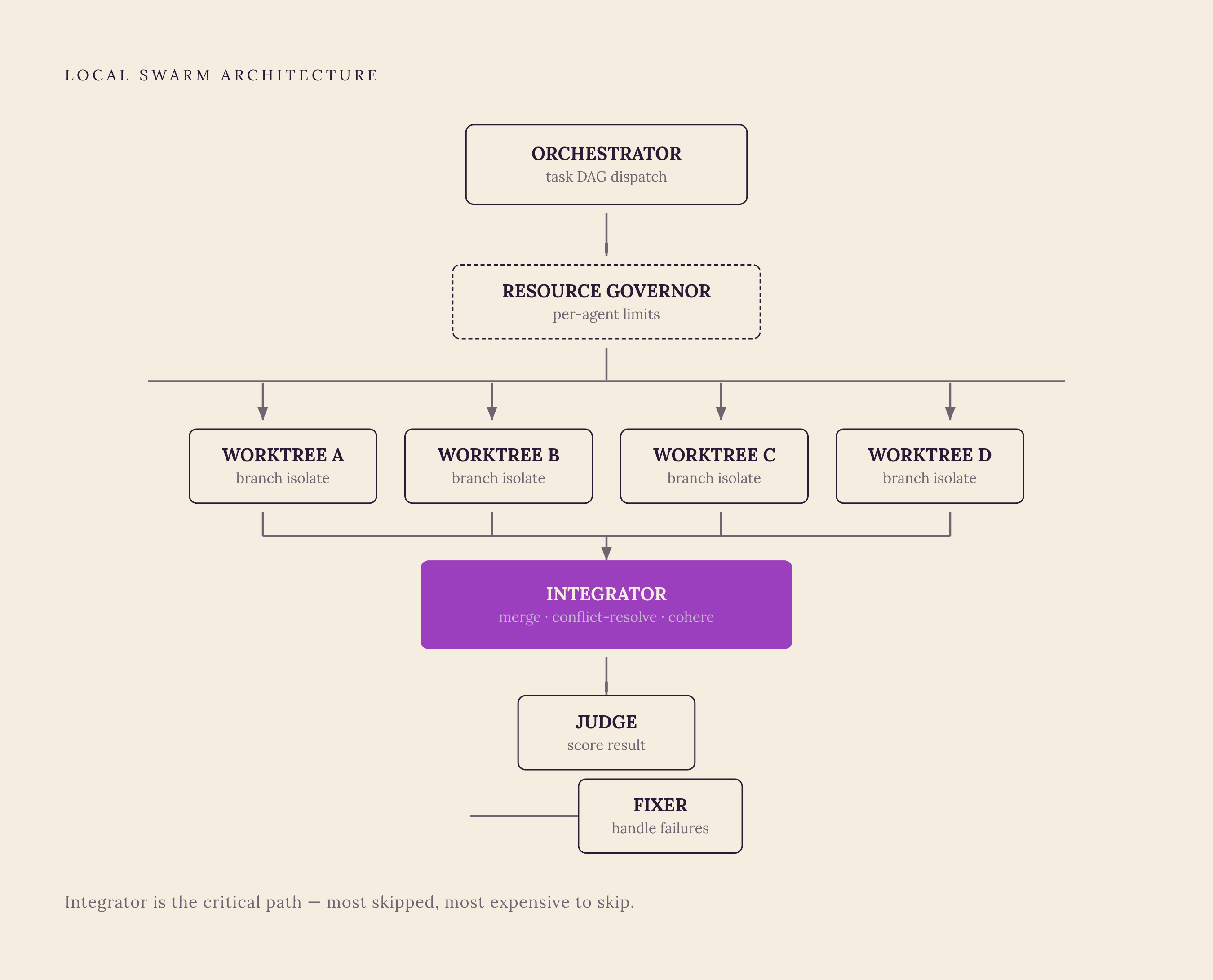
Everything argued so far collapses into four components that have to be wired together for a local swarm to actually run: an orchestrator process managing the task DAG, per-agent worktrees sitting on isolated branches, a resource governor enforcing limits per agent, and a merge strategy for collecting what each agent produces.
Kilo Desktop extends that further by supporting local model execution alongside access to vetted packages and models, which makes it a self-contained local swarm environment inside an IDE developers already know.
Build an approval gate before agents commit to shared state into any of these setups by hand. Requiring explicit human sign-off before a commit lands keeps a developer genuinely in the loop, and it doesn't have to stall the swarm to do it: agents can keep working inside their own worktrees while a prior step sits waiting for approval, so the gate adds a checkpoint without freezing the whole system.
Merge strategy: how to reconcile parallel branches without losing coherence
Merge quality traces directly back to decomposition quality. Tasks that were genuinely independent from the start produce merges that standard tooling resolves cleanly. Tasks with hidden coupling, the kind that looked separable on paper but weren't, produce semantic conflicts no merge tool is built to catch.
The Swarm Diaries describes a dedicated integrator agent for exactly this gap. The integrator doesn't write new code. It reconciles what the parallel agents produced, after which a separate judge scores the merged result; if that quality gate fails, the loop sends the work back to a fixer agent. That integrator role takes on a task that would otherwise land on a human: noticing that two agents solved the same problem two different ways, and deciding which solution survives or how the two get combined.
Running tests, linting, and a scoring pass after the merge is the swarm's version of continuous integration. It's what turns a merge from a hopeful guess into a checkpoint the team can actually trust, and it's the point where every earlier decision, how the task was split, how the agents were isolated, how the machine's resources were governed, either holds up under verification or doesn't.