Task Decomposition Strategies for Coding Agent Swarms
How you split work among coding agents matters more than model choice.
- Written by
- Priya Nandakumar
- Published
- November 20, 2026
- Reading time
- 8 min read
- Sources cited
- 5 sources ↓
What this covers
- Why decomposition strategy matters more than model quality in coding swarms
- What goes wrong when decomposition is absent or uncoordinated
- Plan-and-execute: separating the decomposition decision from task execution
- Hierarchical decomposition: how a supervisor-worker structure manages dependencies and specialization
Coding agent swarms produce reliable, mergeable work or expensive coordination failures depending on their task decomposition strategies. Model capability remains important, but the stronger architectural lever is how the system divides work, enforces boundaries, and responds when a subtask fails. Plan-and-execute, hierarchical delegation, and runtime-structured decomposition make different commitments on those decisions. Their value depends on matching the strategy to the work.
Why decomposition strategy matters more than model quality in coding swarms
Meta and Harvard’s Confucius Code Agent used Claude Sonnet 4.5 with a custom scaffold on a software engineering benchmark and achieved performance that model swaps alone could not explain. The result points beyond model selection. Scaffolding and decomposition shape how much reasoning each agent must sustain and how its output becomes part of a larger change.
Augment Code says smaller, testable units keep agents within the range of work they can reliably get right. That range narrows as task complexity grows. Decomposition therefore determines more than the number of agents running at once. Manageable individual reasoning loops and an auditable execution graph for their combined work depend on decomposition.
What goes wrong when decomposition is absent or uncoordinated
Parallel agents with separate context windows cannot see one another’s changes as they work, even when Git supports their separate branches. Routing tables, configuration files, and component registries are places where changes clash because many features touch them. The resulting failures differ in visibility and severity. Same-line merge conflicts are easy to detect and partly resolvable automatically, while duplicated implementations require architectural awareness. Semantic contradictions are harder still because incompatible behavior can pass compilation and linting.
Context exhaustion introduces another failure mode as an agent’s assigned work exceeds its manageable working set. Failures also accumulate across unchecked handoffs. Even when each agent succeeds most of the time, the system can fail when each stage depends on outputs from earlier stages. SwarmBench, introduced by Gao et al. in 2026, attributes swarm failures to unstable decomposition, unreasonable delegation, and weak result integration. It finds that aggregation is often the hardest capability to stabilize, so successfully completed subtasks can still yield an unsuccessful whole.
Plan-and-execute: separating the decomposition decision from task execution
Plan-and-execute creates a task graph before execution begins, separating reasoning about the work’s structure from reasoning about each step. A separate execution loop then follows the plan and may revise it when conditions change. Monitoring can compare observed execution with the plan, while revision and cost control operate against an explicit artifact.
A specification preserves long-horizon intent while small tasks define explicit file and interface boundaries. Its workflow moves through Specify, which establishes user journeys and success criteria, and Plan, which identifies dependencies and integration points. Tasks then defines independently testable units, while Implement assigns generation to agents and verification to humans at checkpoints.
The limitation is the default control structure. The decomposition can change, but it is usually set before execution starts. Invalid intermediate outputs or newly discovered branching conditions therefore require a full or partial replan. A visible plan improves accountability, but visibility alone does not give that plan a way to respond locally to failure.
Hierarchical decomposition: how a supervisor-worker structure manages dependencies and specialization
Hierarchical decomposition gives a central orchestrator responsibility for goals, dependencies, and agent roles while specialists receive bounded assignments. It supports both parallel work and sequential dependencies. The orchestrator can reason about the split after seeing the code, rather than follow a script written without that context. Hub-and-spoke communication also keeps coordination observable, whereas dense peer-to-peer communication expands the coordination surface and makes failures harder to isolate.
HyperAgent illustrates this division of responsibility on SWE-Bench Lite. Its Planner processes issues and develops resolution strategies, then coordinates Navigator, Editor, and Executor agents through an asynchronous message queue. An iterative planning and feedback loop connects their work. Meta’s Ranking Engineer Agent uses orchestration for jobs that run over several days through Validation, Combination, and Exploitation, within budgets that engineers have approved. Its REA Executor hibernates during training jobs and resumes when results arrive.
These structures provide specialization without eliminating decomposition risk. Parallelism pays only when subtasks are genuinely independent, while sequential planning can lose more to coordination than it gains from additional agents. Most current delegation still relies on prompt engineering heuristics, with learned policies less common. An orchestrator can therefore inspect the repository and revise assignments yet still make weak decomposition decisions. Hierarchy organizes responsibility, but does not make the reasoning behind each assignment reliable.
Why static decomposition can be worse than no decomposition at all
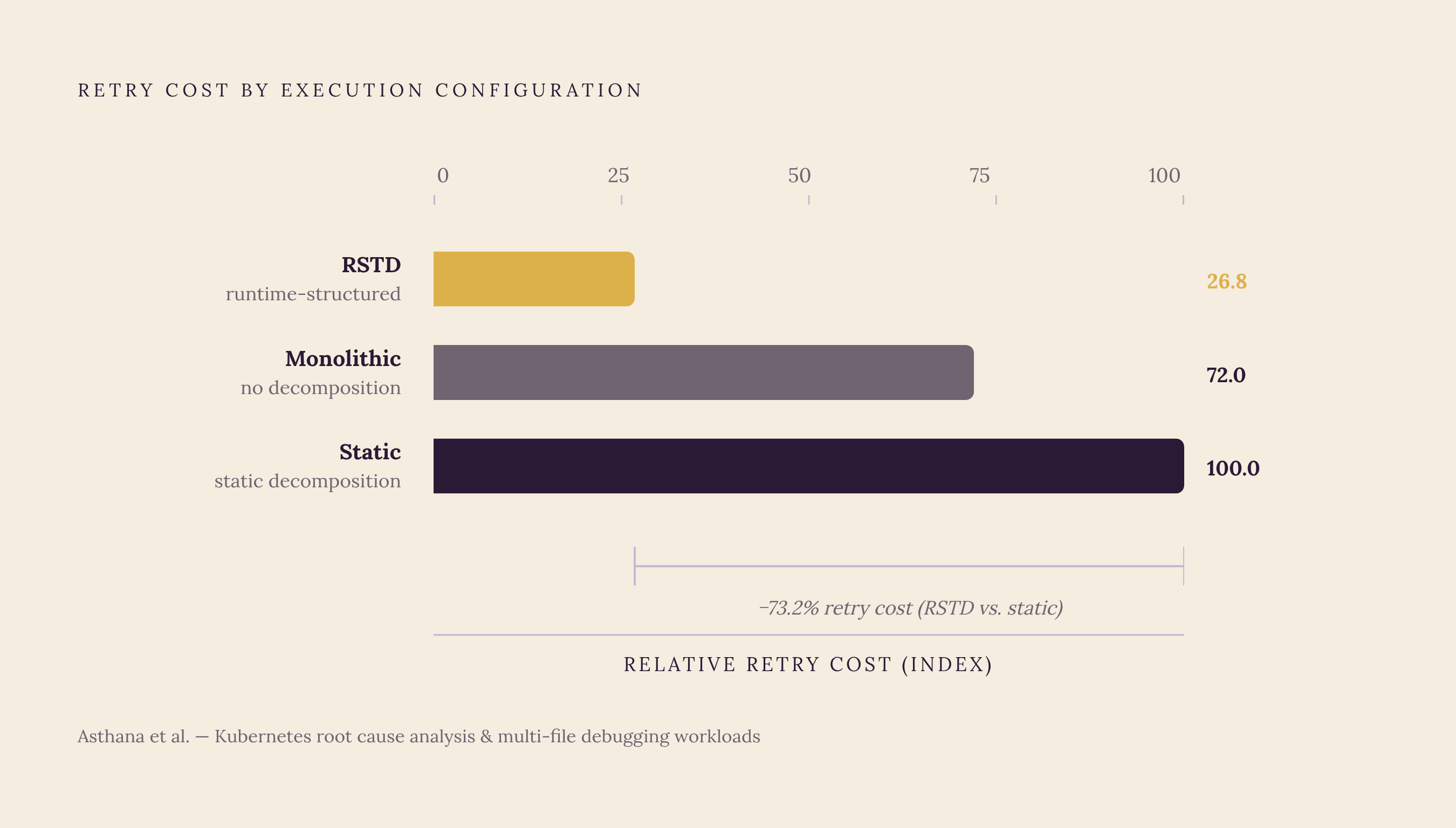
Asthana et al. found that static decomposition increased retry cost relative to monolithic execution in a Kubernetes root cause analysis workload. Multi-file debugging also had higher retry cost, but the increase was smaller. This is a substantial objection to decomposition by default. Splitting work into named stages can cost more without giving the system the control it needs to contain failures.
The mechanism is a fixed sequential graph with no runtime branching. When a subtask fails, execution must repeat the work from that failure point forward. Pipeline depth then amplifies retry cost.
Relay chains that add stages without new information or branching logic can fall below random-chance baselines on certain tasks. In constrained local or edge settings, separating planning from grounding can likewise reduce success while increasing computation because formatting and planning requirements introduce additional failure modes. These findings identify runtime branching as the mechanism behind lower retry costs.
Runtime-structured decomposition: isolating failures at the subtask level
Runtime-structured task decomposition, or RSTD, moves control flow and branching out of prompt text and into executable code. Models perform narrowly scoped judgment tasks, and schema validation checks their outputs before downstream execution. The system can then identify which subtask produced invalid output. Instead of treating every failure as a reason to repeat the pipeline, it can retry that subtask selectively.
Asthana, Zhang, DeLuca, Patel, and Mahindru presented the approach at ACM CAIS 2026. Their evaluation used the Mellea generative computing framework to compare monolithic, static, and runtime-structured configurations across multiple runs. Across Kubernetes root cause analysis and multi-file debugging, RSTD achieved a 73.2% reduction in retry cost over static decomposition baselines. Both workloads also showed improved debuggability and operational reliability.
The operational distinction is where recovery decisions live. Moving branching from prompt behavior into executable orchestration makes it observable, traceable, and reproducible. Schema-constrained outputs provide the precision needed for selective retry. However, this remains a research-frontier approach with evidence of its benefits limited to specific workloads. Its strongest result concerns the cost of recovering from failure under those conditions.
What makes tasks genuinely decomposable, and when swarms earn their token cost
Broad search, independent investigation, repeated checks, test generation, and migrations with clear boundaries give swarms useful work to divide. Their subtasks can run in isolation and produce outputs that merge without semantic contradiction. Independence is the decisive property. A large task is not necessarily parallelizable, and a small task may still depend tightly on sequential context.
Linear execution chains and write-heavy work often favor one well-scoped agent because coordination adds expense without removing those dependencies. Open-ended, long-horizon work presents another difficulty when self-management failures outweigh the benefits of parallel execution. Today’s agents do better on tasks with clear limits than on work that calls for sustained multi-file reasoning. The architecture needs to account for token consumption from the start so that the cost of running it comes as no surprise later.
When Xu Yang et al. tested Co-Coder in 2026 across 28 real-world tasks on DevEval and CodeProjectEval, its biggest gains were on the projects with the most dependencies. Complexity can create opportunities as well as constraints. Decomposition needs to expose independent work within that complexity. Project difficulty alone does not establish a case for either a swarm or a single agent.
Coordination infrastructure that makes decomposition decisions stick
Augment Code grounds its coordination approach in six patterns that connect explicit task boundaries to controlled integration. Spec-scoped tasks define the work, while separate git worktrees isolate each agent’s in-flight changes. Isolation protects execution, while agreement between implementations requires separate verification. Tests and automated quality gates before merge add a boundary that catches behavioral failures that compilation and linting can miss. Sequential merges then control integration even when implementation proceeds in parallel.
Role separation gives those controls distinct owners. A coordinator manages the whole change, specialists execute focused tasks, and a verifier examines completed work before errors propagate downstream. Dedicated verification can expose cross-branch contradictions that agents cannot see from their private contexts. The division also reduces semantic drift by avoiding assignments that ask one agent to juggle several roles.
Shared state needs similarly deliberate treatment. Hub-and-spoke state management keeps shared context with one orchestrator, preserving observability and making failures easier to isolate than dense peer-to-peer sharing. Private agent namespaces with writes gated behind locking provide a defensive arrangement for concurrent writes. Together, these mechanisms make the decomposition plan enforceable and its outputs easier to audit.
How SwarmBench exposes orchestration quality as a measurable, improvable property
SwarmBench evaluates models as swarm orchestrators rather than treating the final answer as the only useful evidence. Its tasks include root cause analysis, treasure hunt game, and wide search. It checks accuracy, efficiency, cost, and the quality of the process. The process dimension separates task decomposition, dynamic subagent creation and delegation, and result aggregation, allowing failures to be attributed to particular orchestration stages.
The benchmark finds that today’s models differ in what they can do well. Stronger models get better cost-performance tradeoffs and are more likely to make work more efficient when it is split into parallel structures. Model capability is therefore not irrelevant. However, the gains depend on effective orchestration, and aggregation remains difficult even when decomposition and delegation succeed. Single-agent benchmarks cannot expose these distinctions adequately.
SwarmExp uses prior trajectories to improve that orchestration. It extracts skill, trick, and model card information and reinjects it into the main agent’s context, consistently improving orchestration performance in the reported evaluation. Harder long-horizon evaluations such as SWE-EVO reinforce the need for this process-level measurement as established benchmarks become less discriminating.
What engineers should own as decomposition moves from pattern to production infrastructure
Plan-and-execute calls for investment in specification quality and explicit boundaries because the plan governs downstream work. Hierarchical systems require strong orchestrator prompts, auditable delegation, and a communication topology that preserves observability. Runtime-structured systems require schemas and deterministic orchestration code that support selective retry. Each choice creates a distinct maintenance obligation.
The practical decision begins with task shape. Token budgets belong in that decision from the first design sketch because coordination overhead is structural. Verification also needs its own stage, rather than appearing only after implementation has finished.
Augment Code provides a practical route through these infrastructure requirements with living specs, isolated worktrees, coordinator, specialist, and verifier roles, and built-in git integration for sequential merges. Teams can use those mechanisms without having to build the whole coordination layer themselves. Tooling does not remove the architectural responsibility. The engineer’s contribution is deciding where work can be separated, which boundaries must hold, and what evidence is required before independently generated changes become one trusted result.
Methodology & sources
- Runtime-Structured Task Decomposition for Agentic Coding Systems
Supplied the RSTD approach and the 73.2% retry-cost reduction over static decomposition in Kubernetes root cause analysis and multi-file debugging.
- SwarmBench: Can Large Language Models Act as Agent Swarm Orchestrators?
Provided the SwarmBench evaluation of orchestration quality, including failure attribution and the finding that aggregation is hardest.
- [2605.15425] Runtime-Structured Task Decomposition for Agentic Coding Systems
Abstract page for the same RSTD paper, backing the description of runtime-structured decomposition and its limits.
- When Sub-Agents Work in Parallel: The Promises and Pitfalls of Dynamic Concurrency in Long-Horizon Coding Tasks
Informed the discussion of when parallel sub-agents help or hurt, including self-management failures and token cost in long-horizon coding tasks.
- From Question Answering to Task Completion: A Survey on Agent System and Harness Design[v1]
Survey of agent system and harness design that covers plan-and-execute and hierarchical patterns, and the cases where separating planning from grounding hurts.